

Elamite Empire
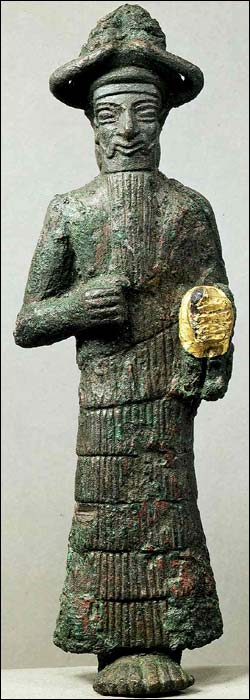 |
| Elamite God, Susa, Iran Beginning of the 2nd millennium BCE |
T
he
Iranian Plateau did not experience the rise of urban, literate
civilization in the late 4th and early 3rd millennia on the Mesopotamian
pattern but the lowland Khuzestan did. It was the Elamite
Civilization.
Geographically,
Elam included more than Khuzestan; it was a combination of the lowlands
and the immediate highland areas to the north and east. Elamite
strength was based on an ability to hold these various areas together
under a coordinated government that permitted the maximum interchange of
the natural resources unique to each region. Traditionally this was
done through a federated governmental structure.
Closely
related to that form of government was the Elamite system of
inheritance and power distribution. The normal pattern of government was
that of an overlord ruling over vassal princes. In earliest times the
overlord lived in Susa, which functioned as a federal capital. With him
ruled his brother closest in age, the viceroy, who usually had his seat
of government in the native city of the currently ruling dynasty. This
viceroy was heir presumptive to the overlord. Yet a third official, the
regent or prince of Susa (the district), shared power with the overlord
and the viceroy. He was usually the overlord's son or, if no son was
available, his nephew. On the death of the overlord, the viceroy became
overlord. The prince of Susa remained in office, and the brother of the
old viceroy nearest to him in age became the new viceroy. Only if all
brothers were dead was the prince of Susa promoted to viceroy, thus
enabling the overlord to name his own son (or nephew) as the new prince
of Susa. Such a complicated system of governmental checks, balances, and
power inheritance often broke down despite bilateral descent and
levirate marriage (i.e., the compulsory marriage of a widow to her
deceased husband's brother). What is remarkable is how often the system
did work; it was only in the Middle and Neo-Elamite periods that sons
more often succeeded fathers to power.
Elamite
history can be divided into three main phases: the Old, Middle, and
Late, or Neo-Elamite, periods. In all periods Elam was closely involved
with Sumer, Babylonia, and Assyria, sometimes through peaceful trade,
more often through war. In like manner, Elam was often a participant in
events on the Iranian Plateau. Both involvements were related to the
combined need of all the lowland civilizations to control the warlike
peoples to the east and to exploit the economic resources of the
plateau.
Old Elamite Period
The
earliest kings in the Old Elamite period may date to approximately 2700
BCE. Already conflict with Mesopotamia, in this case apparently with
the city of Ur, was characteristic of Elamite history. These early
rulers were succeeded by the Awan (Shustar) dynasty.
The
11th king of this line entered into treaty relations with the great
Naram-Sin of Akkad (c. 2254 - c. 2218 BCE). Yet there soon appeared a
new ruling house, the Simash dynasty (Simash may have been in the
mountains of southern Luristan). The outstanding event of this period
was the virtual conquest of Elam by Shulgi of the 3rd dynasty of Ur (c.
2094 - c. 2047 BCE). Eventually the Elamites rose in rebellion and
overthrew the 3rd Ur dynasty, an event long remembered in Mesopotamian
dirges and omen texts. About the middle of the 19th century BCE, power
in Elam passed to a new dynasty, that of Eparti. The third king of this
line, Shirukdukh, was active in various military coalitions against the
rising power of Babylon, but Hammurabi (c. 1792 - c. 1750 BCE) was not
to be denied, and Elam was crushed in 1764 BCE. The Old Babylon kingdom,
however, fell into rapid decline following the death of Hammurabi, and
it was not long before the Elamites were able to gain revenge.
Kutir-Nahhunte I attacked Samsuiluna (c. 1749 - c. 1712 BCE),
Hammurabi's son, and dealt so serious a defeat to the Babylonians that
the event was remembered more than 1,000 years later in an inscription
of the Assyrian king Ashurbanipal. It may be assumed that with this
stroke Elam once again gained independence. The end of the Eparti
dynasty, which may have come in the late 16th century BCE, is buried in
silence.
Middle Elamite Period
After
two centuries for which sources reveal nothing, the Middle Elamite
period opened with the rise to power of the Anzanite dynasty, whose
homeland probably lay in the mountains northeast of Khuzestan. Political
expansion under Khumbannumena (c. 1285 - c. 1266 BCE), the fourth king
of this line, proceeded apace, and his successes were commemorated by
his assumption of the title "Expander of the Empire." He was succeeded
by his son, Untash-Gal (Untash (d) Gal, or Untash-Huban), a contemporary
of Shalmaneser I of Assyria (c. 1274 - c. 1245 BCE) and the founder of
the city of Dur Untash (modern Chogha Zanbil).
In
the years immediately following Untash-Gal, Elam increasingly found
itself in real or potential conflict with the rising power of Assyria.
Tukulti-Ninurta I of Assyria (c. 1244 - c. 1208 BCE) campaigned in the
mountains north of Elam. The Elamites under Kidin-Khutran, second king
after Untash-Gal, countered with a successful and devastating raid on
Babylonia.
In
the end, however, Assyrian power seems to have been too great.
Tukulti-Ninurta managed to expand, for a brief time, Assyrian control
well to the south in Mesopotamia, Kidin-Khutran faded into obscurity,
and the Anzanite dynasty came to an end.
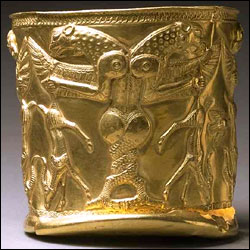 |
| Golden Vase with Winged Monsters Marlik Region, Iran 14th-13th centuries BCE |
After
a short period of dynastic troubles, the second half of the Middle
Elamite period opened with the reign of Shutruk-Nahhunte (c. 1160 BCE).
Two equally powerful and two rather less impressive kings followed this
founder of a new dynasty, whose home was probably Susa, and in this
period Elam became one of the great military powers of the Middle East.
Tukulti-Ninurta died about 1208 BC, and Assyria fell into a period of
internal weakness and dynastic conflict. Elam was quick to take
advantage of this situation by campaigning extensively in the Diyala
River area and into the very heart of Mesopotamia. Shutruk-Nahhunte
captured Babylon and carried off to Susa the stela on which was
inscribed the famous law code of Hammurabi. Shilkhak-In-Shushinak,
brother and successor of Shutruk-Nahhunte's eldest son, Kutir-Nahhunte,
still anxious to take advantage of Assyrian weakness, campaigned as far
north as the area of modern Kirkuk. In Babylonia, however, the 2nd
dynasty of Isin led a native revolt against such control as the Elamites
had been able to exercise there, and Elamite power in central
Mesopotamia was eventually broken. The Elamite military empire began to
shrink rapidly. Nebuchadrezzar I of Babylon (c. 1124 - c. 1103 BCE)
attacked Elam and was just barely beaten off. A second Babylonian attack
succeeded, however, and the whole of Elam was apparently overrun,
ending the Middle Elamite period.
It
is noteworthy that during the Middle Elamite period the old system of
succession to, and distribution of, power appears to have broken down.
Increasingly, son succeeded father, and less is heard of divided
authority within a federated system. This probably reflects an effort to
increase the central authority at Susa in order to conduct effective
military campaigns abroad and to hold Elamite foreign conquests. The old
system of regionalism balanced with federalism must have suffered, and
the fraternal, sectional strife that so weakened Elam in the Neo-Elamite
period may have had its roots in the centrifugal developments of the
13th and 12th centuries BCE.
Neo-Elamite Period
A
long period of darkness separates the Middle and Neo-Elamite periods.
In 742 BCE a certain Huban-nugash is mentioned as king in Elam. The land
appears to have been divided into separate principalities, with the
central power fairly weak.
The
next 100 years witnessed the constant attempts of the Elamites to
interfere in Mesopotamian affairs, usually in alliance with Babylon,
against the constant pressure of Neo-Assyrian expansion. At times they
were successful with this policy, both militarily and diplomatically,
but on the whole they were forced to give way to increasing Assyrian
power. Local Elamite dynastic troubles were from time to time compounded
by both Assyrian and Babylonian interference. Meanwhile, the Assyrian
army whittled away at Elamite power and influence in Luristan. In time
these internal and external pressures resulted in the near total
collapse of any meaningful central authority in Elam. In a series of
campaigns between 692 and 639 BCE, in an effort to clean up a political
and diplomatic mess that had become a chronic headache for the
Assyrians, Ashurbanipal's armies utterly destroyed Susa, pulling down
buildings, looting, and sowing the land of Elam with salt.

Elamite Kings:
 |
| Funerary Head of an Elamite, Susa, Iran 15th-14th centuries BCE |
Avan Dynasty (precise dates unknown)
Peli (fl. c. 2500 BCE)
Tata (precise dates unknown)
Ukku-Takhesh (precise dates unknown)
Khishur (precise dates unknown)
Shushun-Tarana (precise dates unknown)
Napil-Khush (precise dates unknown)
Kikku-Sive-Temti (precise dates unknown)
Lukh-Ishshan (fl. c. 2350 BCE)
Khelu (fl. c. 2300 BCE)
Khita (fl. c. 2275 BCE)
Kutik-Inshushinnak (fl. c. 2240 BCE)
Simash Dynasty (precise dates unknown)
Gir-Namme (fl. c. 2030 BCE)
Enpi-Luhhan (fl. c. 2010 BCE)
Khutran-Temtt (precise dates unknown)
Kindattu (precise dates unknown)
Indattu-Inshushinnak I (precise dates unknown)
Tan-Rukhurater (precise dates unknown)
Indattu-Inshushinnak II (precise dates unknown)
Indattu-Napir (precise dates unknown)
Indattu-Tempt (precise dates unknown)
Elam Dynasty (precise dates unknown)
Eparti I (precise dates unknown)
Eparti II (precise dates unknown)
Eparti III (fl. c. 1850 BCE)
Shilkhakha (precise dates unknown)
Attakhushu (fl. c. 1830 BCE)
Sirukdukh (fl. c. 1792 BCE)
Shimut-Wartash (c. 1772 - c. 1770 BCE)
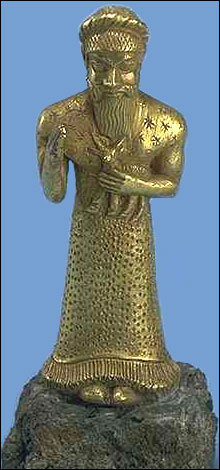 |
| Elamite worshipper, Susa, Iran 12th century BCE |
Babylonian Dynasty (c. 1770 - c. 1500 BCE)
Siwe-Palar-Khuppak (c. 1770 - c. 1745 BCE)
Kuduzulush I (c. 1745 - c. 1730 BCE)
Kutir-Nahhunte I (c. 1730 - c. 1700 BCE)
Lila-Ir-Tash (c. 1700 - c. 1698 BCE)
Temti-Agun I (c. 1698 - c. 1690 BCE)
Tan-Uli (c. 1690 - c. 1655 BCE)
Temti-Khalki (c. 1655 - c. 1650 BCE)
Kuk-Nashur II (c. 1650 - c. 1635 BCE)
Kutir-Shilkhakha I (c. 1635 - c. 1625 BCE)
Temti-Raptash (c. 1625 - c. 1605 BCE)
Kuduzulush II (c. 1605 - c. 1600 BCE)
Tata (c. 1600 - c. 1580 BCE)
Atta-Merra-Khalki (c. 1580 - c. 1570 BCE)
Pala-Ishshan (c. 1570 - c. 1545 BCE)
Kuk-Kirwash (c. 1545 - c. 1520 BCE)
Kuk-Nahhunte (c. 1520 - c. 1505 BCE)
Kutir-Nahhunte II (c. 1505 - ???? BCE)
Igehalkid Dynasty (c. 1350 - c. 1200 BCE)
Ige-Halki (c. 1350 - c. 1330 BCE)
Pakhir-Ishshan (c. 1330 - c. 1310 BCE)
Attar-Kittakh (c. 1310 - c. 1300 BCE)
Khuman-Numena (c. 1300 - c. 1275 BCE)
Untash-Naprisha (c. 1275 - c. 1240 BCE)
Unpatar-Naprisha (c. 1240 - c. 1235 BCE)
Kiddin-Khutran (c. 1235 - c. 1210 BCE)
Interregnum period (c. 1210 - c. 1200 BCE)
Shutrukid Dynasty (c. 1205 - c. 1100 BCE)
Khallutush-In-Shushinak (c. 1205 - c. 1185 BCE)
Shutruk-Nahhunte (c. 1185 - c. 1155 BCE)
Kutir-Nahhunte III (c. 1155 - c. 1150 BCE)
Shilkhak-In-Shushinak (c. 1150 - c. 1120 BCE)
Khutelutush-In-Shushinak (c. 1120 - c. 1110 BCE)
Shilhana-Hamru-Lagamar (c. 1110 - ???? BCE)
Late Elam Dynasty (743 - 644 BCE)
Khumbanigash I (743 - 717 BCE)
Shuttir-Nakhkhunte (717 - 699 BCE)
Khallushu (699 - 693 BCE)
Kutir-Nakhkhunte (693 - 692 BCE)
Khumma-Menanu (692 - 689 BCE)
Khumma-Khaldash I (689 - 681 BCE)
Khumma-Khaldash II (681 - 680 BCE)
Khumma-Khaldash II & Shilhak-In-Shushinak (680 - 676 BCE)
Shilhak-In-Shushinak & Urtaku (676 - 664 BCE)
Shilhak-In-Shushinak & Tempti-Khumma-In-Shushinak (664 - 653 BCE)
Atta-Khumma-In-Shushinak & Khumbanigash II (653 - 651 BCE)
Atta-Khumma-In-Shushinak & Tammaritu (651 - 649 BCE)
Atta-Khumma-In-Shushinak & Indabigash (649 - 648 BCE)
Indabigash (648 - 647 BCE)
Khumma-Khaldash III (647 - 644 BCE)
 10 شاخه و روش اصلی کسب درآمد اینترنتی با روزانه 500 هزار تومان
 دانلود کتاب سر المستتر شیخ بهایی، در علوم غریبه، جفر و خوابنامه